
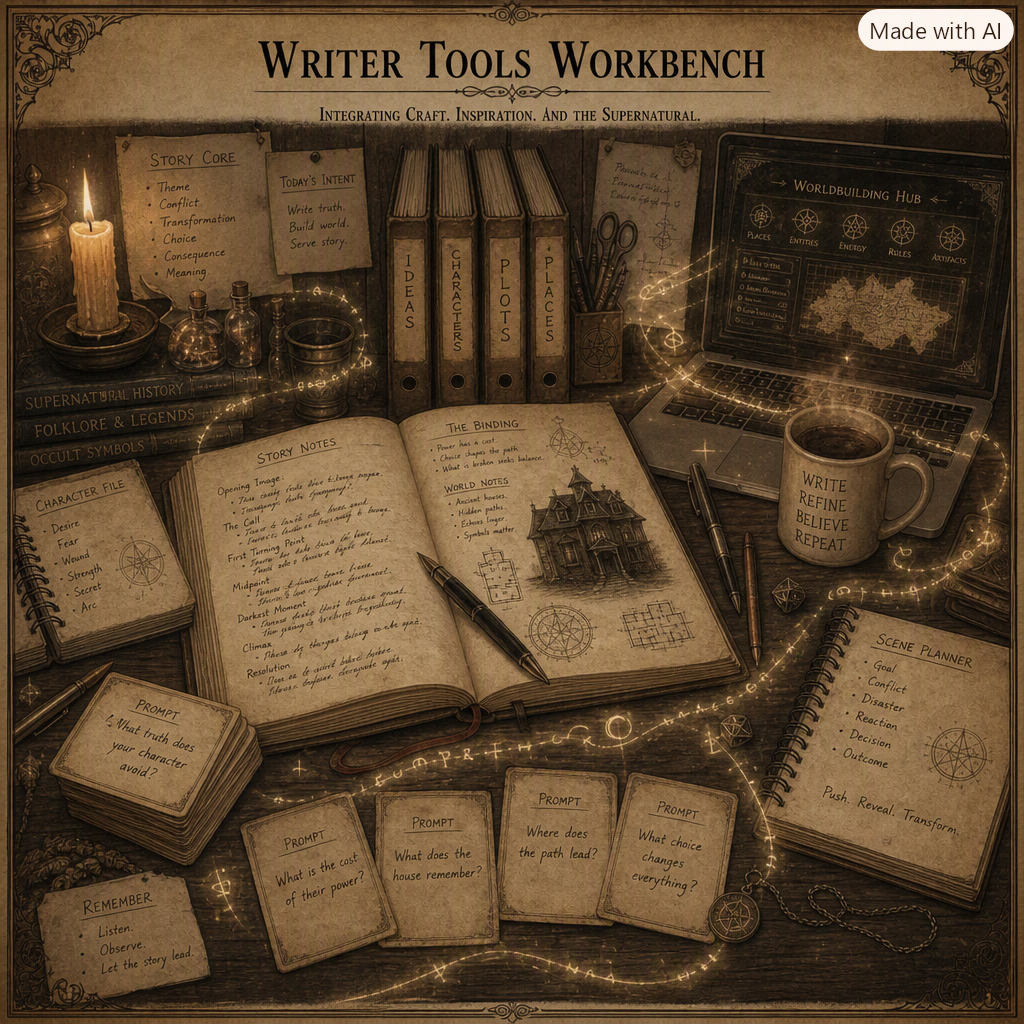
Week Four of our Ultimate Halloween Worldbuilding Series
Supernatural fiction thrives on mystery, tension, and the sense that unseen forces are always at work—but the stories that linger with readers do more than simply frighten. Beyond the initial shock, the stories feel designed. They feel alive. They feel like the supernatural world has its own rules, history, and internal logic despite the seeming chaos. Throughout the past three weeks of our Halloween Worldbuilding Series, we’ve explored the individual building blocks that make these stories so compelling: haunted houses that remember, ghosts that ache, witches who intervene, curses that bind, rituals that unlock, monsters that enforce, and demons that scheme.
Yet even with strong individual elements, supernatural fiction becomes truly powerful when these elements stop functioning in isolation and begin integrating with one another. A ghost becomes more haunting when its sorrow is woven into a curse. A monster becomes more terrifying when it guards a ritual site. A haunted house becomes more oppressive when a demon has claimed it as territory. In these moments of overlap, when these systems integrate—overlapping, influencing, and colliding—your story gains depth, cohesion, and mythic weight.
With that in mind, this final week is devoted to integrating your supernatural elements into a single, unified ecosystem. Integration is the craft that transforms a collection of spooky ideas into a world with intention. It’s the difference between a story that merely scares and a story that resonates.
To bring everything together, this concluding installment, we’ll explore how supernatural systems reinforce one another, how to structure an integrated supernatural narrative, and how writer tools can help you manage the complexity of a living, breathing supernatural world. By the end, you’ll have a framework for building stories that feel atmospheric, emotionally rich, and powerfully interconnected.
Part One – Integrating Your Supernatural Systems
A supernatural story feels intentional when every element connects. Integration is the process of weaving these elements into a single narrative fabric so that each one strengthens the others.
Why Integrating Matters
When your supernatural systems interact, your story becomes more than a sequence of eerie events. Integration allows you to:
- Avoid disconnected scares.
- Create layered conflict.
- Deepens emotional stakes.
- Builds mythic lore.
- Makes your world feel ancient and alive.
A well-integrated supernatural world feels like it has existed long before the protagonist arrived – and will continue long after they leave.
The Core Principle of Integrating
Every supernatural element should follow do the following things.
- Each element should affect every other element.
- Each element should be affected by every other element.
This reciprocal relationship is what transforms a collection of spooky ideas into a functioning supernatural ecosystem.
Part Two – Integrating the Supernatural Ecosystem
Let’s take a look at how each supernatural system interacts with the others. These relationships are not rules, rather, they are patterns that help you build a world where every element has a purpose.
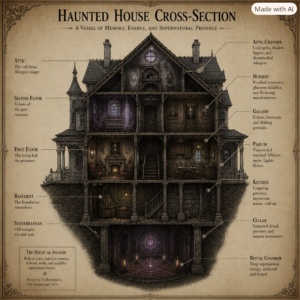
Haunted Houses – The Vessel
The haunted house is the container for your supernatural story. It can:
- Hold the history that created the ghost.
- Contain the ritual site.
- Shelter or hide the monster.
- Enforce or amplify the curse.
- Serve as the demon’s territory or prison.
- Provide the witch a home.
Example: A family moves into an old farmhouse where the hallways subtly shift at night. At first, they assume it’s a ghost rearranging the space. But the truth is more complex: the house itself is cursed, reshaping its architecture to trap anyone who gets close to the hidden ritual chamber beneath the floorboards. The ghost isn’t trying to scare them, rather, it’s trying to guide them to the room where the curse was cast.
A haunted house is never just a location – it’s a character in its own right with memory, intention, and influence.
Ghosts – The Emotional Engine
Ghosts carry the emotional weight of your supernatural world. They:
- Reveal the curse’s origin.
- Require a ritual for release.
- Fear or warn the monster.
- Be manipulated by the demon.
- Are bound to the house’s history.
Example: A ghost appears only when a specific lullaby is played. The protagonist assumes it’s sentimental, that is, until they discover the lullaby is actually part of a ritual that weakens the curse binding the ghost to the house. The ghost’s sorrow becomes the key to understanding the supernatural logic at work.
Ghosts remind readers that the supernatural is rooted in human experience – loss, regret, injustice, longing.
Witches – The Practitioners
Witches are the active agents within your supernatural ecosystem. They:
- Create or break curses.
- Perform rituals.
- Summon or banish demons.
- Bind or confront monsters.
- Communicate with ghosts.
Example: A witch attempts a protection ritual for a small town; however, a mispronounced incantation summons a creature that stalks the woods. The monster isn’t random—it’s the ritual’s unintended consequence. To banish it, the witch must gather ingredients guarded by the very creature her spell created.
A witch’s choices often determine whether the supernatural world spirals into chaos or finds resolution.
Curses – The Logic
Curses give your supernatural world structure. They:
- Shape the house’s behavior.
- Trap ghosts.
- Transform humans into monsters.
- Attract demons.
- Require rituals to break.
Example: A bloodline curse transforms one family member into a monster every generation. The current monster prowls the abandoned estate, enforcing the curse’s rules. A witch arrives to break the curse, but doing so will destroy the monster—who is actually her estranged brother.
A curse is the rulebook of your supernatural ecosystem – its logic, its consequences, its boundaries.
Rituals – The Mechanisms
Rituals are the tools characters use to interact with the supernatural. They:
- Break curses.
- Free ghosts.
- Bind monsters.
- Banish demons.
- Activate the house’s hidden mechanisms.
Example: A ritual to banish a demon requires the emotional energy of fear. The protagonist must confront the monster in the attic—not to defeat it, but to generate enough fear to power the ritual. The ghost tries to help, but its calming presence weakens the ritual’s potency.
Rituals create agency. They give characters a way to fight back.
Monsters – The Physical Danger
Monsters embody the physical threat within your supernatural world. They:
- Enforce curses.
- Guard ritual sites.
- Threaten witches.
- Fear or serve demons.
- Haunt the house’s forbidden spaces.
Example: A twisted stag‑like creature roams the forest, its antlers carved with runes—the same runes found in the curse plaguing the protagonist’s family. The monster isn’t hunting them; it’s warning them that the curse is nearing its final stage.
Monsters turn supernatural tension into immediate danger.
Demons – The Intention
Demons provide direction and motive. They:
- Create curses.
- Manipulate witches.
- Tempt protagonists.
- Command monsters.
- Claim territory within the haunted house.
Example: A demon claims the attic of a boarding school. Students report nightmares of climbing stairs. The demon isn’t attacking them—it’s marking them as potential vessels. Meanwhile, the haunted house’s architecture begins shifting to funnel students upward, amplifying the demon’s influence.
Demons give your supernatural world a mind of its own.
When all of these systems interact, the story becomes cohesive, mythic, and emotionally resonant.
Part Three – Structuring an Integrating Supernatural Narrative
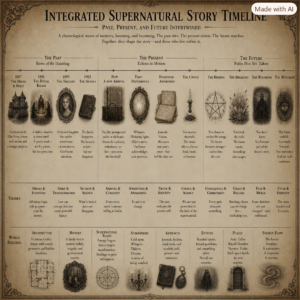
Here is a complete example of how all systems can interlock within a single narrative.
- Arrival
The protagonist enters the haunted house.
- Disturbances
Ghost activity begins – at first small, emotional, and symbolic.
- Symptoms
A curse activates, therefore escalating the haunting.
- Lore
The protagonist eventually uncovers the ritual needed to break the curse.
- First Encounter
A monster now appears as the curse’s enforcer.
- Invitation
A demon offers a bargain to “solve” the haunting.
- Revelation
The protagonist learns the demon actually created the curse.
- Escalation
The house reacts violently as supernatural forces collide.
- Confrontation
The protagonist eventually performs the ritual.
- Climax
The ghost is freed, the monster destroyed, the demon is banished; either that or the protagonist fails.
- Aftermath
The house becomes quiet – its story is resolved, or so we believe.
- Epilogue
A final detail hints that the supernatural world remains active.
This structure shows how each supernatural system can escalate tension, deepen mystery, and guide the protagonist toward resolution.
Part Four – Tools for Integrating the Supernatural
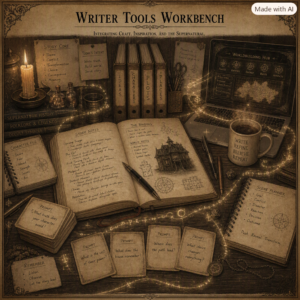
Integration is powerful – but it is complex. Writer tools help you manage the complexity and build your supernatural world with intention.
Worksheets
Worksheets help you break each system into essential questions:
- Origins
- Rules
- Behaviors
- Emotional stakes
- Symbolic elements
These questions help you define each supernatural element clearly before weaving them together.
Checklists
Checklists, on the other hand, help ensure consistency across the various systems, including:
- Supernatural rules
- Emotional arcs
- Escalation patterns
- Symbolic objects
- Story logic
A checklist keeps your world coherent along with the complexity of a growing story.
Prompts
Prompts help spark new ideas that, usually, help expand your world. Consider these:
- Haunted house anomalies
n return
- Ghost motivations
- Witch spells
- Curse consequences
- Ritual components
- Monster symbolism
- Demon bargains
Prompts are especially useful when you feel stuck or when supernatural elements feel underdeveloped.
Part Five – Bringing It All Together: Integrating Your World
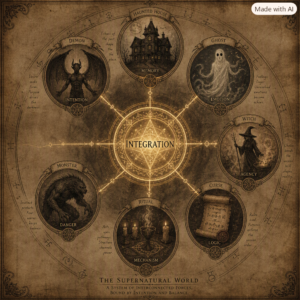
So, we come to the end of our four-week series. We have explored:
- Haunted houses
- Ghosts
- Witches
- Curses
- Rituals
- Monsters
- Demons
- Integration
- Writer tools
And so we arrive at the end of our Halloween Worldbuilding Series, standing at the threshold of a fully realized supernatural ecosystem. You’ve built the seven pillars of supernatural fiction — and now you’ve learned the final, most transformative craft: integrating them.
Integrating your supernatural systems is the spell that binds your world together. It’s what turns scattered phenomena into mythology. When your haunted house reacts to your curse, when your ghost fears your monster, when your demon manipulates your witch, your story becomes more than fiction — it becomes legend.
Carry this final lesson with you. Keep integrating your supernatural elements so they collide, conspire, and resonate. Let your world feel ancient and alive while continuing to grow. And when your story ends, leave one last detail unsettled — a reminder that the supernatural continues humming beneath the floorboards.




 by

Leave a Reply