Week Three of our Ultimate Halloween Worldbuilding Series
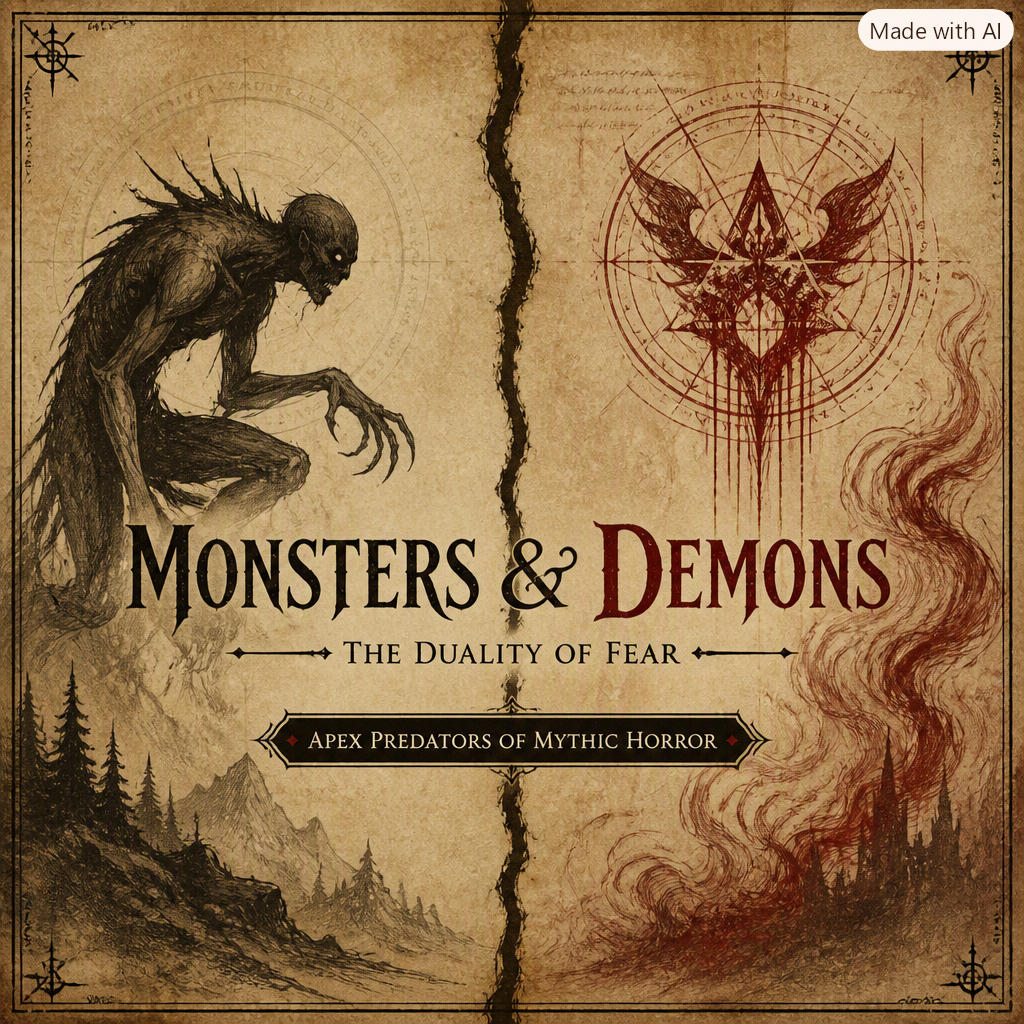
Monsters and demons, they are the things that live in the closet and under the bed. Additionally, they are the lurkers in the dark, whether just off the beaten path or in the abandoned building, and they are watching. Supernatural fiction escalates when danger becomes both physical and moral. Monsters introduce visceral threat – teeth, claws, pursuit, transformation. Demons introduce intellectual and ethical threat – temptation, manipulation, unholy bargains, corruption. Together, they form the apex predators of the supernatural ecosystem.
This week’s installment in the Halloween Worldbuilding Kit explores how monsters and demons function, how they differ, and how they can be used to create powerful, mythic horror.
Part One – Monsters: The Physical Manifestation of Fear
Monsters are not simply creatures. They are the embodiments of fear, guilt, trauma, corruption, or ancient punishment. A monster’s presence forces characters to confront dangers they cannot reason with or escape through logic alone.
What Makes a Monster Work
Monsters are more than just big scary (or small scary) creatures that attack you at the first opportunity. Something strange jumping out of the shadows technically qualifies as a monster, but a true monster has to have more to it than just big teeth and claws. To create a strong monster your readers will love – or hate – you need to give them a story of their own.
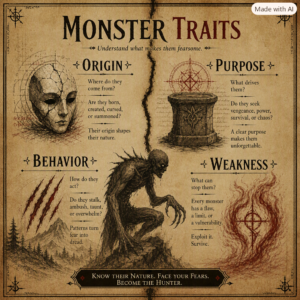
First, a strong monster needs the following.
- Origin: How did the creature come into being? Is it the result of a curse, a ritual, a mutation, a myth, some sort of trauma, or was it created by man? Mary Shelley gave us Frankenstein’s monster; a being created in a lab. This made him more than just a big, scary monster, it gave the reader someone to sympathize with.
- Purpose: Your monster’s needs a purpose. Does it protect something? Does it punish someone? Is it an enforcer of sorts? Sticking with Frankenstein’s monster, it, or rather, he was created just so Victor could prove it could be done.
- Behavior: This is how your monster acts. Does it have a hunting pattern? Is it tied to a specific territory? What is its intelligence level? The Monster was fine until his knowledge began to grow and he realized he was nothing more than an experiment. At that point, his behavior began to change, and he became more vengeful and aggressive.
- Weakness: This is your monster’s vulnerability. In most cases, its origin ties to its weaknesses. Continuing with the Monster, his weakness, at least in the movies, became fire. (Seems like a broad and mundane thing. Most living things don’t fare well when it comes to an out-of-control fire.)
Monsters give your supernatural world teeth.
Monster Story Structure
A monster-driven narrative typically follows this progression.
- The Disturbance: Signs of the monster’s presence begin to appear – tracks, missing animals, or strange noises.
- The Lore: Clues reveal the monster’s origin and purpose.
- The First Encounter: The protagonist sees the creature’s true nature and realizes the danger.
- The Pattern: The monster’s behavior becomes predictable enough to study.
- The Escalation: The protagonist catches the monster’s attention, and he or she becomes the main target.
- The Confrontation: A trap, a ritual, or symbolic act forces a final showdown.
- The Resolution: The monster is destroyed, transformed, escaped, or revealed to be part of a larger system.
Monsters turn fear into confrontation.
Part Two – Demons: The Intellectual and Moral Antagonists
In contrast, demons are not simply creatures or monsters – they are strategists with ulterior motives. They tempt, manipulate, bargain, and, corrupt. Their power lies in more than just physical strength; it also lies in psychological influence and mythic intention.
ultimately,
What Makes a Demon Work
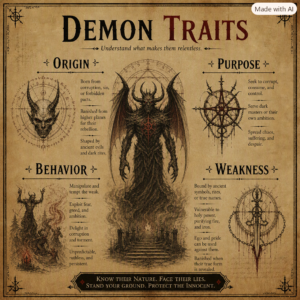
Not all demons are physically strong; they are all crafty. Furthermore, they all want something. Be it freedom, to complete a task, or vengeance, they will work tirelessly to achieve it. To create a demon that works, you have to give them the following.
- Motivation: Demons do very little without having some sort of reason. In most cases, this motivation ties into what it wants from the protagonist.
- Rules: As powerful as s demon might appear, they do have to follow certain rules. They are bound by the bargains they make, the conditions in which they were summoned, or other limitations.
- Manifestation: This is how the demon appears (not how it looks.) Does it appear in dreams? Is it a reflection in a mirrored surface? Is its presence known simply by the sound of its voice? Or does it appear as nothing more than an apparition? A non-physical appearance can increase the terror.
- Strategy: Demons are master manipulators. Regardless of what they do, their underlying goal is to push the protagonist toward a decision – one that does not end favorably for the protagonist.
Demon Story Structure
Similarly, a demon-driven story structure typically follows this progression.
- The Invitation: The demon makes first contact, usually through a whisper, a vision, or a bargain. Often, the characters don’t realize they are not the initiator.
- The Temptation: A good demon can sense your desires so that is the thing it will offer the protagonist.
- The Terms: A good bargain also has to have guidelines. Your demon with be truthful in offering you something, but its truth is often misleading.
- The Influence: Its influence starts small but, eventually spreads through dreams, objects, or even emotional pressure.
- The Escalation: The demon begins to tighten its grip on the protagonist. It will manipulate events or increase the danger.
- The Revelation: The protagonist finally discovers the demons’ true motives and motivation.
- The Bargain: The protagonist now accepts, rejects, or outsmarts the demon.
- The Consequence: The demon meets its fate. It can be banished, bound, fulfilled, or simply left waiting for another opportunity.
Demons turn fear into temptation.
Part Three: How Monsters and Demons Interact
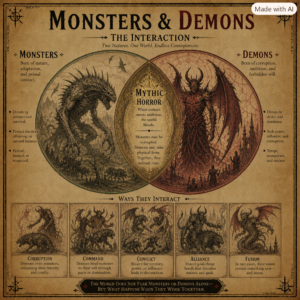
Monsters and demons represent two sides of supernatural danger – both physical and moral. When used together, they create layered conflict.
Monsters and Demons Together
- A demon may create or control a monster.
- A monster may guard something the demon wants.
- A demon may manipulate the protagonist into confronting the monster.
- A monster may be the physical consequence of a demon’s bargain.
- A demon may use a monster as leverage or threat.
Symbolic Interaction
- Monsters represent external danger.
- Demons represent internal danger.
- Together, they force the protagonist to confront both fear and desire.
This pairing of monsters and demons creates mythic horror – so danger is both physical and psychological.
Next Week: Integration & Writer Tools
Next week’s installment finally brings everything together. We’ll explore how haunted houses, ghosts, witches, curses, rituals, monsters, and demons interlock to form a cohesive supernatural ecosystem. We will also see how worksheets, checklists, and prompts help you build one with clarity and intention.




 by

Leave a Reply